
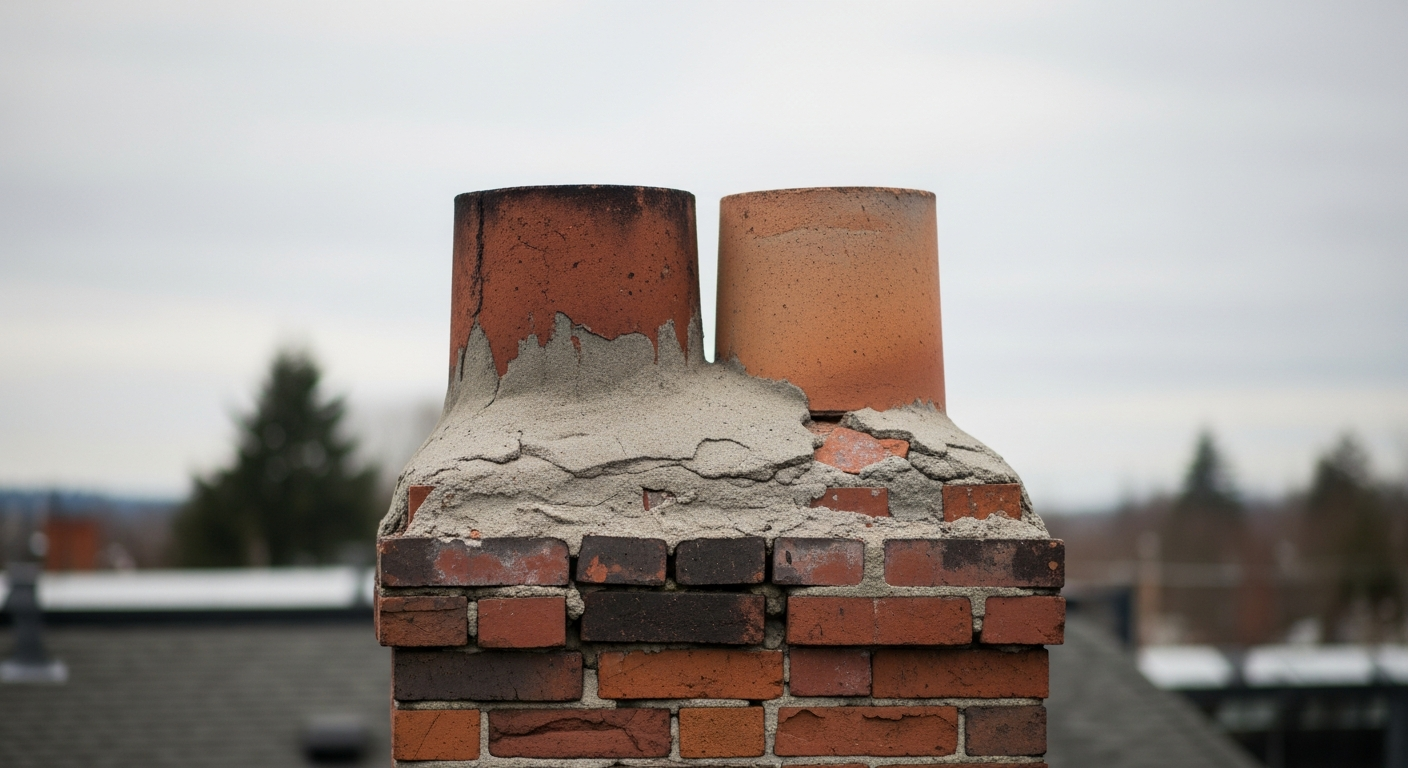
Pre-war Seattle masonry chimneys — most of them built between 1900 and 1945 — deteriorate in ways that are genuinely difficult to diagnose, and quotes for the same chimney can vary by thousands of dollars because contractors are not always scoping the same work. Understanding what tuckpointing, partial rebuilds, and flue relining each actually fix will let you cross-examine any proposal before you sign.
Why Old Seattle Masonry Is a Special Case
Seattle's wet winters are relentless. A chimney that was laid in 1922 has absorbed a century of freeze-thaw cycles, moss infiltration, and the occasional earthquake tremor from a region that sits on soft alluvial soil. The mortar joints on a 100-year-old stack were almost certainly mixed with a lime-heavy formula that is softer and more water-soluble than modern Portland-cement mortars — which sounds like a weakness but is actually by design. Soft mortar is meant to sacrifice itself to protect the harder brick. The problem arrives when that mortar is gone and no one has replaced it.
Beyond the exterior, the flue tile inside a pre-war chimney was often installed without the airspace and insulation that modern codes require, and many of those original clay liners are now cracked, offset, or missing sections entirely.
Illustrative Scenario
Consider Edward, a hypothetical buyer who closes on a 1924 Craftsman bungalow in Phinney Ridge. His inspection report notes "mortar deterioration" and recommends a chimney specialist. He calls three companies. One quotes $400 for tuckpointing. A second quotes $3,200 for a partial rebuild to the roofline. A third quotes $6,800 for a full reline plus crown replacement. All three contractors have looked at the same chimney. Edward has no framework for deciding whether any of these scopes is right — or whether all three are partially right for different parts of the same structure. This guide gives him that framework.
The Three Main Interventions — and What Each One Actually Fixes
Tuckpointing Tuckpointing (sometimes called repointing) removes deteriorated mortar from the joints between bricks and packs in fresh mortar. It addresses *surface water infiltration and structural loosening of individual courses*. It does not fix cracked bricks, a damaged crown, a leaning stack, or a compromised flue liner. When tuckpointing is recommended on a chimney where the bricks themselves are spalling or the stack is visibly out of plumb, the scope is almost certainly underestimating the real condition.
Partial or Full Rebuilds A partial rebuild tears down and relays courses of brick from some point on the stack — often from the roofline up, since that exposure gets the worst weather. A full rebuild goes to the firebox or beyond. This work is appropriate when brick faces are spalling deeply, when the stack has shifted, or when the crown (the concrete cap that sheds water) has failed structurally. In Seattle's climate, the section above the roofline on a chimney built before World War II commonly needs at least a partial rebuild by the time the house is 80 to 100 years old.
Flue Relining The flue liner is a separate system from the masonry shell. Relining installs a new continuous liner — typically stainless steel flexible liner or a cast-in-place product — inside the existing flue. It addresses *combustion safety and code compliance*, not structural masonry problems. A cracked clay tile liner allows carbon monoxide and heat to escape into the surrounding structure; a reline corrects that. However, relining alone does not stop water from entering through failed mortar joints. The two scopes solve different problems and are sometimes both needed. See Signs Your Chimney Needs Relining: A Seattle Homeowner's Guide for the specific warning signs that indicate liner failure.
Typical Seattle Cost Ranges by Scope
The table below reflects typical market ranges in the Seattle/Puget Sound area as of recent years. Actual quotes vary by chimney height, access difficulty, and material costs at time of service. Use these as a sanity-check baseline, not a fixed price list.
| Scope | Typical Seattle Range | What It Addresses |
|---|---|---|
| Tuckpointing (repointing) | $300 – $800 | Surface mortar loss, minor water infiltration |
| Crown repair or replacement | $250 – $600 | Water entry at top of stack |
| Partial rebuild (above roofline) | $1,500 – $4,500 | Spalled brick, shifted courses, structural failure |
| Full rebuild (firebox to top) | $4,000 – $12,000+ | Severe structural deterioration throughout |
| Stainless steel flue reline | $2,000 – $5,000 | Cracked or missing clay liner, combustion safety |
| Cast-in-place liner | $3,000 – $7,000 | Same as above, preferred for irregular flue shapes |
Red Flags in a Quote for an Old Seattle Chimney
A well-matched proposal for a century-old chimney should explain *why* each line item is needed based on observed conditions — ideally documented with photos from a camera inspection of the flue. Watch for these mismatches:
- A tuckpointing quote on a chimney with visible brick spalling. Spalling means the brick face itself is breaking away; mortar repair alone will not stop further deterioration.
- A reline recommendation with no mention of the exterior masonry condition. Relining a chimney whose shell is admitting water is a partial fix at best.
- A rebuild quote that does not specify how many courses, from what point, and with what brick. Vague scope language makes cost comparison impossible.
- Any quote delivered without a camera inspection of the flue on a chimney this age. Guessing at liner condition on a 100-year-old stack is not adequate diagnosis.
For a broader look at how to evaluate contractor behavior before you commit, Chimney Repair Red Flags: How to Avoid Getting Ripped Off in Seattle covers the patterns that consistently show up in complaint records.
How to Compare Quotes Fairly
Request that every contractor provide a written scope that separately itemizes tuckpointing, masonry repair, crown work, and any flue work with linear footage. Ask each one to show you the photos that justify each line item. Then compare scopes, not just totals. A $3,200 quote that includes a partial rebuild and crown replacement may be more reasonable than a $1,800 quote limited to tuckpointing on a chimney that genuinely needs both.
When you are evaluating companies, the ranking scores Seattle-area chimney contractors on eight public measures including technician credentials, complaint history, and price transparency — useful context when you are trying to distinguish a thorough contractor from one who is either underselling or overselling the work your 1924 bungalow actually needs.
Frequently asked questions
- How do I know if my old Seattle chimney needs tuckpointing, a rebuild, or a reline — or all three?
- Each addresses a different problem. Tuckpointing fixes mortar joint loss at the surface. A rebuild replaces structurally failed or severely spalled brick courses. A reline replaces a cracked or deteriorated flue liner inside the stack. A century-old Seattle chimney can need any combination of these simultaneously. A camera inspection of the flue and a close exterior inspection from the roof are both necessary before a contractor can honestly say which scopes apply.
- Why are chimney quotes for pre-war Seattle homes so wildly different?
- Contractors are frequently not scoping the same work. One may quote only the most visible surface problem; another may recommend full remediation of every deficiency found. Aging masonry also involves genuine diagnostic uncertainty — the condition of original clay tile liners, for example, is not visible without a camera. Ask each contractor to itemize scope separately and show the inspection photos that justify each line item, then compare scopes rather than totals.
- Is it safe to use a fireplace in a 100-year-old Seattle home before having the chimney inspected?
- No. Pre-war clay flue liners crack over decades, and a cracked liner can allow carbon monoxide and heat to escape into the wall cavity. Seattle's seismic activity can also shift liner sections out of alignment without visible exterior symptoms. A Level 2 chimney inspection — including a camera scan of the flue — is the standard recommendation any time ownership of a home changes, per the Chimney Safety Institute of America.