
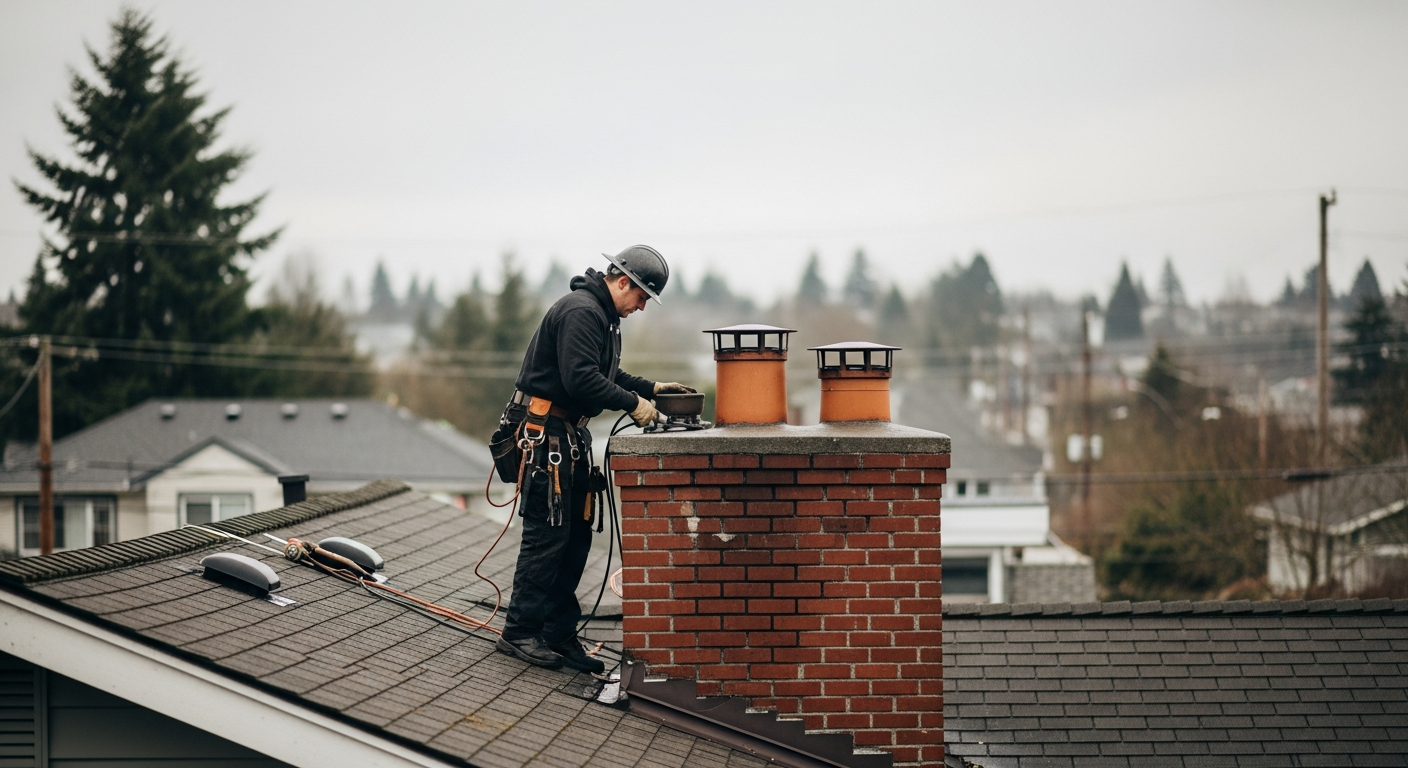
Hiring an unlicensed chimney sweep in Seattle is riskier than most homeowners realize. Washington State requires chimney contractors to register with the Department of Labor & Industries (L&I), carry a surety bond, and hold general liability and workers' compensation insurance. If your sweep has none of those, you may be personally liable for injuries on your roof and have no bonded recourse if the work causes damage.
Why This Problem Is Common in Seattle
Chimney sweeping looks simple from the outside — a brush, a van, and a ladder. That low barrier to entry attracts operators who skip the paperwork and pass the savings on as a suspiciously cheap quote. In the Puget Sound market, where wet winters create steady demand, a homeowner who searches quickly and books the first result can easily end up with an unregistered contractor.
As our guide Top of Google Isn't the Best Chimney Company — It's Who Paid explains, search rank reflects an advertising budget, not a license status.
What Registration Actually Requires in Washington
Under Washington State law (RCW 18.27), any contractor who is paid to perform construction, alteration, or repair work — chimney sweeping and relining included — must be registered with L&I. Registration requires:
- A surety bond ($6,000 for general contractors; $4,000 for specialty contractors as of current L&I schedules — confirm current amounts at lni.wa.gov)
- General liability insurance (minimum $50,000 per occurrence for specialty registration)
- Workers' compensation coverage for any employees
- A valid UBI (Unified Business Identifier) number
Certification through the Chimney Safety Institute of America (CSIA) or the National Chimney Sweep Guild (NCSG) is voluntary and separate. Both are worth having, but neither substitutes for L&I registration.
The Scenario: A Door-Knock in Ballard
Consider Edward, a Ballard homeowner who gets a knock at the door in October. A man in a branded polo shirt says he's doing jobs in the neighborhood this week and can sweep Edward's chimney today for $79 — cash preferred. Edward checks the company name on his phone; the website looks professional. He books the job.
The sweep works on the roof, loses his footing, and sprains his wrist. Because the contractor carried no workers' compensation insurance, Edward's homeowner's policy is exposed to a claim. When Edward later discovers a liner crack the sweep said he'd repaired but hadn't, there's no bond to file against and no registered business address to pursue.
This scenario is hypothetical, but the legal mechanics are real and well-documented in Washington State contractor law.
How to Cross-Check Before Anyone Touches Your Flue
Step 1 — Ask for the registration number. A legitimate contractor will give it to you without hesitation. It appears on their L&I registration certificate and should be on their written estimate.
Step 2 — Verify it yourself at lni.wa.gov. Go to the Contractor Verify tool, enter the name or registration number, and confirm the registration is *active* — not expired or suspended. An expired registration is as problematic as none.
Step 3 — Confirm insurance is current. The L&I lookup shows the certificate of insurance on file. If it expired last year, the contractor is effectively uninsured.
Step 4 — Request a written quote. Unregistered operators often insist on verbal agreements and cash payment. A written, itemized estimate is a baseline professional standard. See Chimney Repair Red Flags: How to Avoid Getting Ripped Off in Seattle for what a trustworthy quote looks like.
The Numbers: What Proper Credentials Should Look Like
| Check | Green Flag | Red Flag |
|---|---|---|
| L&I registration status | Active, current | Expired, suspended, or not found |
| Surety bond | On file with L&I | Not listed or lapsed |
| General liability insurance | $50,000+ per occurrence, current | Absent or expired |
| Workers' comp | Covers all field technicians | Owner-only exemption with employees on site |
| Written estimate | Itemized, on company letterhead | Verbal only, cash preferred |
| Typical Seattle sweep price range | $150–$300 for a standard sweep | Under $100 with pressure to upsell |
Typical price ranges are based on publicly available quotes from Seattle-area contractors and are provided as general guidance, not guarantees.
Your Liability if a Worker Is Injured
Washington is one of the stricter states on this point. If a contractor's employee is injured on your property and the contractor lacks workers' compensation coverage, Washington's Department of Labor & Industries can pursue the property owner as the "employer of last resort" in some circumstances. Your homeowner's insurer may also dispute coverage if you knowingly hired an unregistered contractor. The cost of that exposure dwarfs any discount you received on the sweep.
How Our Ranking Accounts for Credentials
The ranking this site publishes evaluates Seattle-area chimney companies on eight public measures, one of which is verified license and insurance status. No company appears in a ranked position without a confirmed active L&I registration. That single filter removes a meaningful share of operators who advertise locally.
One Final Note on Certification
CSIA-certified sweeps have passed a nationally recognized exam on chimney safety, but CSIA certification does not confer legal authority to work in Washington — registration does. Look for both. If you're also assessing whether your chimney needs more than a sweep, the guide Signs Your Chimney Needs Relining: A Seattle Homeowner's Guide walks through what a thorough inspection should reveal.
Verifying a contractor's L&I registration takes about ninety seconds. It is the single most protective step a Seattle homeowner can take before scheduling chimney work.
Frequently asked questions
- How do I check if a chimney sweep is licensed in Washington State?
- Go to the Contractor Verify tool at lni.wa.gov, enter the company name or their L&I registration number, and confirm the status shows 'active.' Also verify that their bond and insurance certificate have not lapsed. The lookup is free and takes less than two minutes.
- Am I liable if an unlicensed chimney sweep is injured on my roof in Seattle?
- Potentially, yes. If the contractor has no workers' compensation coverage and an employee is injured, Washington State law allows L&I to pursue the property owner as the employer of last resort in some situations. Your homeowner's insurer may also contest coverage if you hired an unregistered contractor.
- Is a CSIA-certified chimney sweep automatically licensed in Washington?
- No. CSIA certification is a voluntary national credential that tests technical knowledge — it is separate from Washington State contractor registration under RCW 18.27. You should look for both: active L&I registration for legal protection, and CSIA or NCSG credentials for technical competence.