
Some websites ranking for Seattle chimney services are marketing shells that collect your contact details and sell them to subcontractors you never screened. A genuine local company employs its own technicians, holds a verifiable Washington State contractor license, and has a physical address you can check on Google Maps. Spending five minutes on due diligence before you fill out a contact form can save you from an unvetted stranger showing up on your roof.
Why This Problem Is Common in Seattle
Seattle's growing housing stock — particularly the older bungalows of Ballard, Wallingford, and Capitol Hill — creates steady demand for chimney work. That demand attracts national lead-generation networks that build city-specific landing pages designed to look like neighborhood businesses. The page might say "Seattle Chimney Experts" with a local phone number, but that number routes to a call center that auctions your inquiry to the lowest-bid subcontractor available that day.
As noted in Top of Google Isn't the Best Chimney Company — It's Who Paid, a high search ranking (paid or organic) says nothing about technician quality. Lead-gen operators often out-spend genuine local shops on SEO and Google Ads precisely because their business model is volume, not craft.
The Illustrative Scenario: Edward in Ballard
*This is a hypothetical teaching example, not a real customer story.*
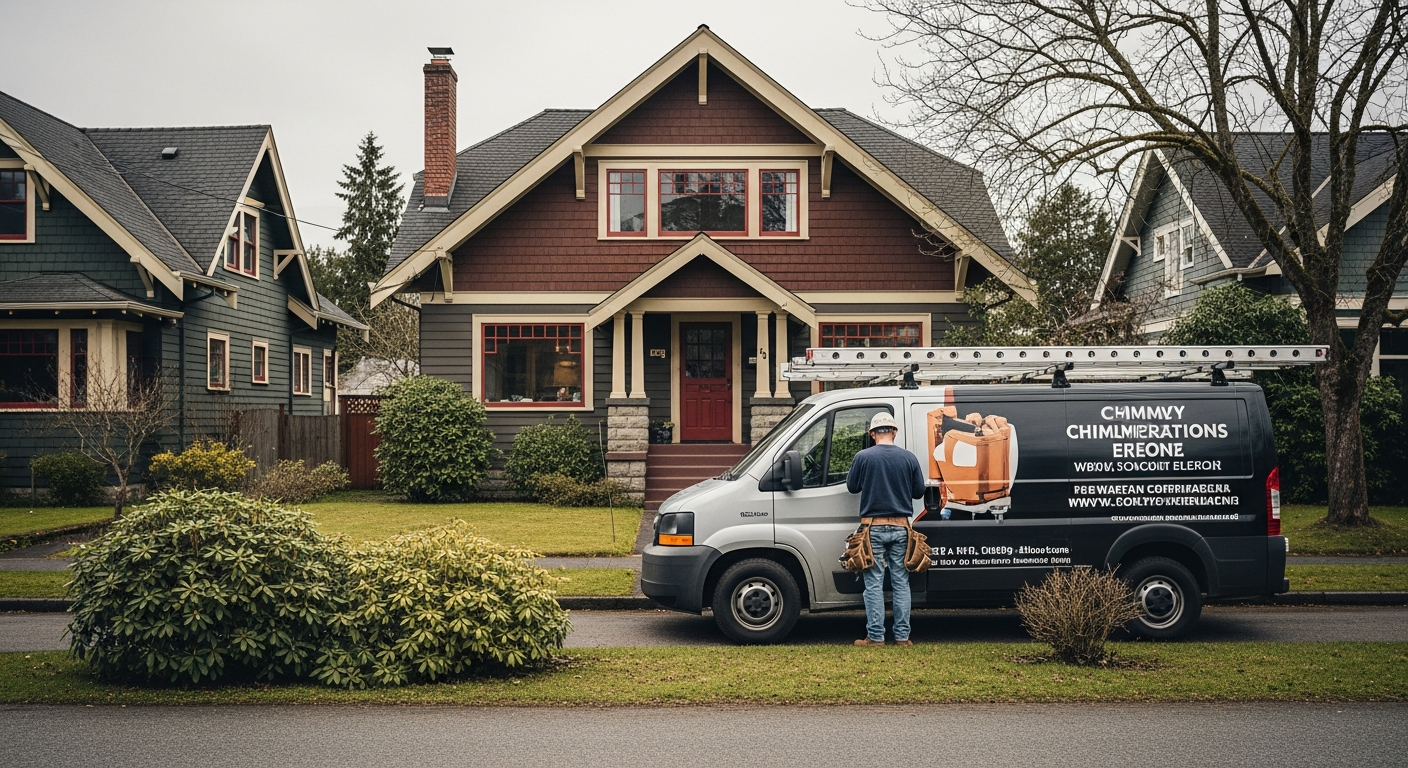
Edward owns a 1928 Craftsman in Ballard and notices smoke backing up into his living room. He searches online, finds a site called "Seattle Fireplace & Chimney Pros," and submits his name and address through a tidy contact form. Within minutes he gets a call — the caller is friendly, quotes a sweep for $89, and books an appointment for the next morning. The technician who arrives drives an unmarked van, carries no business cards, and mentions he is "working with" the company rather than employed by it. He quotes $1,400 in liner repairs after a brief look. Edward has no idea whether the technician holds a Washington State specialty contractor license, carries liability insurance, or has ever been reviewed by anyone he can trace. He never vetted the person — only the website.
How to Tell a Lead-Gen Shell from a Real Business
1. Check the Physical Address
Every Washington State contractor must register a physical business address with the Department of Labor & Industries. Paste the address shown on the website into Google Maps. If it resolves to a UPS Store, a vacant lot, a virtual office suite, or simply does not appear at all, treat that as a serious warning sign. A genuine Seattle chimney company will typically show up as a pin with photos, reviews tied to a consistent address, and a business history on Google's Business Profile.
2. Verify the Washington State Contractor License
Search the company name and owner name at verify.lni.wa.gov. A valid specialty contractor license for chimney work in Washington should be active, bonded, and insured. A lead-gen site often lists no license number, or lists a license belonging to a third party you have never heard of.
3. Look at How Long the Domain Has Existed
Free WHOIS tools (such as whois.domaintools.com) show domain registration dates. A site claiming decades of Seattle experience but registered eighteen months ago is a contradiction worth investigating.
4. Read the "About Us" Page Critically
Lead-gen pages rarely name owners, list employee bios, or show team photos with identifiable Seattle context. Real local shops tend to mention specific neighborhoods, describe how the business was founded, and name the people who do the work.
5. Call and Ask Directly
Ask: "Are you the company that will send the technician, or do you dispatch to subcontractors?" A legitimate company answers without hesitation. Evasion, deflection, or a vague answer about "network partners" is a clear signal.
Red-Flag vs. Green-Flag Signals at a Glance
| Signal | Red Flag (likely lead-gen) | Green Flag (likely real company) |
|---|---|---|
| Physical address | Virtual office, P.O. box, or none | Verifiable street address in greater Seattle area |
| WA contractor license | Not listed or belongs to unknown party | Active, named, searchable at L&I |
| Domain age | Under 2 years for a "veteran" company | Consistent with claimed years in business |
| Who answers the phone | National call center, scripted greeting | Owner or named employee, local familiarity |
| Technician on arrival | Unmarked van, no company ID | Marked vehicle, ID matching the company |
| Pricing structure | Bait-level price, heavy upsell on site | Itemized estimate provided before work starts |
| Reviews | Generic, no local detail, sudden volume | Mention specific neighborhoods, span several years |
For a fuller picture of how we evaluate companies across eight public measures, see the ranking.
Why the Stakes Are Higher Than They Seem
A subcontractor dispatched through a lead-gen network may carry no liability insurance in their own name. If they damage your masonry or start a fire tracing to faulty liner work, your homeowner's insurance claim could become complicated. Washington's Puget Sound climate — wet winters, freeze-thaw cycles, and homes built before modern liner standards — means chimney work done incorrectly has real safety consequences. If you are already noticing performance issues, the Signs Your Chimney Needs Relining: A Seattle Homeowner's Guide explains what legitimate liner problems look like and what repairs should cost, so you can evaluate any quote you receive.
Typical Cost Ranges for Common Seattle Chimney Services
Knowing realistic price bands helps you spot bait pricing immediately.
| Service | Typical Seattle Range | Notes |
|---|---|---|
| Standard chimney sweep | $150 – $300 | Includes basic visual inspection |
| Level 2 video inspection | $200 – $450 | Recommended after any purchase or incident |
| Stainless steel liner installation | $1,800 – $4,500 | Varies by flue length and diameter |
| Firebox repair (minor) | $300 – $800 | Mortar and brick patching |
| Crown coat / waterproofing | $150 – $400 | Preventive; highly relevant in wet PNW climate |
*These are typical ranges drawn from publicly available Seattle-area contractor estimates. Individual quotes will vary based on home age, chimney height, and scope of work.*
A sweep quoted at $49 or $79 is almost always a door-opener for aggressive upselling once a technician is in your home — a pattern described in detail in Chimney Sweep Upsell Scam Seattle: How to Beat It.
The Bottom Line
The most reliable protection is a ten-minute verification routine: confirm the L&I license, map the address, check the domain age, and ask plainly who employs the technician. A company that cannot answer those questions cleanly has told you everything you need to know.
Frequently asked questions
- How can I tell if a Seattle chimney website is a lead-generation front?
- Check whether the business has a verifiable physical address (not a P.O. box or virtual office), an active Washington State specialty contractor license searchable at verify.lni.wa.gov, and a domain age consistent with its claimed years in business. Call and ask directly whether the company employs its own technicians or dispatches subcontractors.
- Is it illegal for a chimney lead-gen site to operate in Washington State?
- Lead generation itself is not illegal, but any contractor who performs chimney work in Washington must hold an active specialty contractor license and carry required bonds and insurance. The problem is not the marketing model — it is when the dispatched subcontractor lacks proper credentials, leaving homeowners with no clear recourse if work is defective or causes damage.
- What should a legitimate chimney company in Seattle be able to show me before work begins?
- A genuine local company should provide their Washington State contractor license number (verifiable at L&I), proof of liability insurance, a written itemized estimate before any work starts, and the full name and employer identification of the technician who will perform the job.