
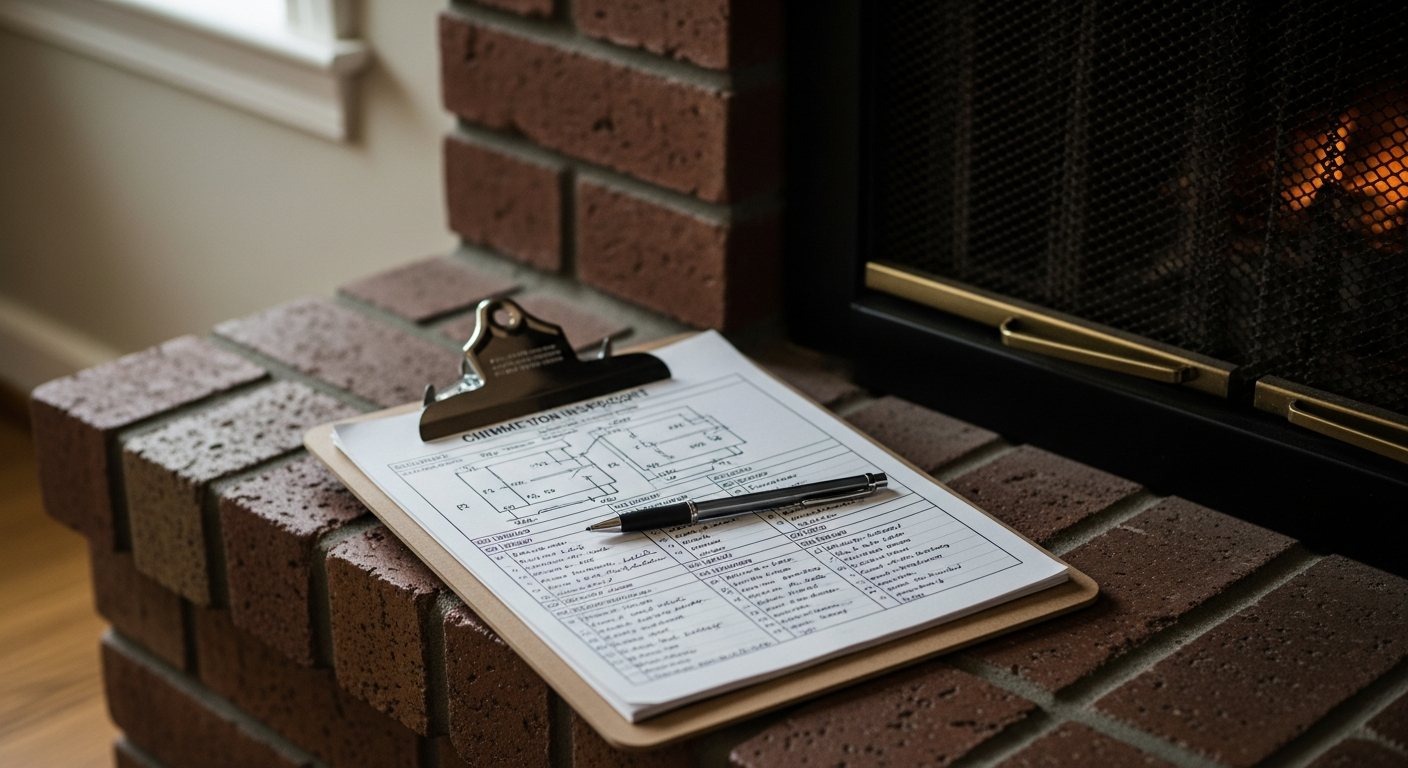
A legitimate chimney inspection report should be a written document — not a verbal summary — that identifies the inspector, describes every system component examined, notes each finding with its condition, and specifies any required action with a cost estimate. In Seattle, where moisture damage and seismic movement make chimneys genuinely complex, a verbal-only "report" leaves you with no way to verify findings, compare contractor bids, or dispute charges added later. Demanding written documentation before the technician leaves is one of the simplest protections available to a buyer.
Why Verbal Reports Are a Protection Gap, Not a Convenience
Imagine Edward, a Ballard homeowner — this is a hypothetical teaching scenario — who pays $175 for a Level I inspection. The technician spends 25 minutes on the job, says the liner "looks rough" and the crown is "cracked pretty bad," and quotes $2,400 in repairs verbally before packing up the van. Edward has no list of what was actually examined, no photographs, and no written description of the liner's condition. Two weeks later, when he calls a second company for a bid, he can't tell them what the first inspector saw — only what he remembers hearing. The second company finds a minor crown chip they quote at $150.
Without a written report, Edward cannot compare findings, cannot tell which description is accurate, and cannot dispute the first company's verbal claims. This scenario is common across Seattle-area neighborhoods, and it is why the written report is the buyer's primary protection — not a courtesy an inspector may or may not provide.
For more context on how upsell pressure typically follows verbal-only findings, see Chimney Sweep Upsell Scam Seattle: How to Beat It.
What a Written Report Must Contain: Level I vs. Level II
The National Fire Protection Association's NFPA 211 standard defines three inspection levels. Most residential inspections in Seattle fall under Level I (accessible areas, basic use) or Level II (change of occupancy, after a seismic event, or real-estate transaction). The written output for each level differs in scope, not in the expectation that a written record exists.
Every Report — Level I or Level II — Should Include
- Inspector identification: full name, company name, Washington State contractor license number, and whether they hold a CSIA (Chimney Safety Institute of America) Certified Chimney Sweep credential
- Inspection date and property address
- Fireplace/appliance type: wood-burning, gas insert, oil, pellet, or combination
- Inspection level performed: explicitly stated as Level I or Level II
- Component-by-component condition table: each element listed, its observed condition (satisfactory / serviceable / deficient), and a brief plain-language description of any deficiency found
- Photographs: for every deficiency noted; photos should be labeled with the component name
- Clearances: confirmation that combustible clearances meet current code or a note where they do not
- Liner assessment: material (clay tile, stainless, cast-in-place), visible cracks or deterioration, sizing relative to appliance output
- Required action vs. recommended action: these two categories must be separated in writing — a cracked crown that still sheds water is not the same urgency as a liner gap that allows combustion gases into the wall cavity
- Estimated cost range for any required action: a written ballpark, even if a formal bid comes later
- Signature: inspector's signature and date
A Level II report adds documentation of accessible concealed spaces (attic, crawlspace) and, if a video scan was performed, a reference to the scan file and its key findings.
Typical Cost Context for Seattle Inspections
Knowing what you paid helps you calibrate what documentation you should expect. These are typical ranges for the Seattle / Puget Sound area — actual prices vary by company, access difficulty, and home age.
| Service | Typical Seattle Range | Written Report Expected? |
|---|---|---|
| Level I inspection (sweep included) | $150 – $300 | Yes — minimum 1-page written summary |
| Level I inspection (inspection only) | $99 – $175 | Yes — same minimum |
| Level II inspection (with video scan) | $250 – $450 | Yes — written report + scan reference |
| Level II for real-estate transaction | $300 – $500 | Yes — often required by buyer's agent |
If a company charges at the high end of these ranges but delivers only a verbal summary, that is a red flag worth weighing against others in the ranking, which scores companies on eight public measures including technician quality and public complaints.
Red Flags in a Report (and in Its Absence)
A written report can still mislead if it is vague. Watch for these patterns:
- Condition described as "failed" with no photograph — deficiency claims without visual evidence are unverifiable
- No separation between required and recommended repairs — this blurs urgency to push larger sales
- Liner flagged as needing replacement with no sizing calculation — liner replacement is a significant cost; see Signs Your Chimney Needs Relining: A Seattle Homeowner's Guide for what a legitimate liner assessment looks like
- No license number on the document — Washington State requires contractor registration for repair work; an inspector who omits their license number may not hold one
- Report emailed days later — legitimate reports are provided at or shortly after the visit; a report that arrives after you've declined repairs is harder to trust
What to Do Before the Technician Leaves
Ask for the written report before you sign any service agreement or pay the balance. If the company says the report is emailed within 24–48 hours, that is acceptable — ask for written confirmation that no repair recommendation will be finalized until you have reviewed the document. Do not authorize repair work based solely on a verbal description of findings.
If the company cannot tell you what their report contains before the inspection begins, that is itself a signal worth noting. Checking Chimney Repair Red Flags: How to Avoid Getting Ripped Off in Seattle before you book gives you a fuller picture of what legitimate practice looks like.
Frequently asked questions
- Is a chimney company in Seattle legally required to provide a written inspection report?
- Washington State does not have a statute that specifically mandates a written chimney inspection report in the same way it mandates contractor registration. However, NFPA 211 — the professional standard inspectors are expected to follow — requires written documentation for all three inspection levels. If a company charges for an inspection and provides only a verbal summary, you have paid for a service that does not meet the industry's own written standard, and you have limited recourse if the findings are later disputed.
- What is the difference between a Level I and Level II chimney inspection report in Seattle?
- A Level I inspection covers accessible portions of the chimney exterior, interior, and appliance connection. The written report documents those areas and their condition. A Level II inspection adds accessible concealed spaces (attic, crawlspace, basement) and typically includes a video scan of the flue; the written report must reference the scan and summarize its findings. Level II is commonly required for Seattle real-estate transactions, after a seismic event, or when a homeowner changes fuel type or installs a new appliance.
- Can I use a chimney inspection report to get competing bids in Seattle?
- Yes, and this is one of its most practical uses. A written report with component-level condition descriptions and photographs gives a second or third contractor a factual baseline to bid against. Without it, each contractor is essentially inspecting from scratch and you have no way to verify whether their findings match the original inspector's. A detailed written report is particularly valuable for liner replacement quotes, which can range widely — typically $1,500 to $5,000 or more in the Seattle area depending on flue length and material.