
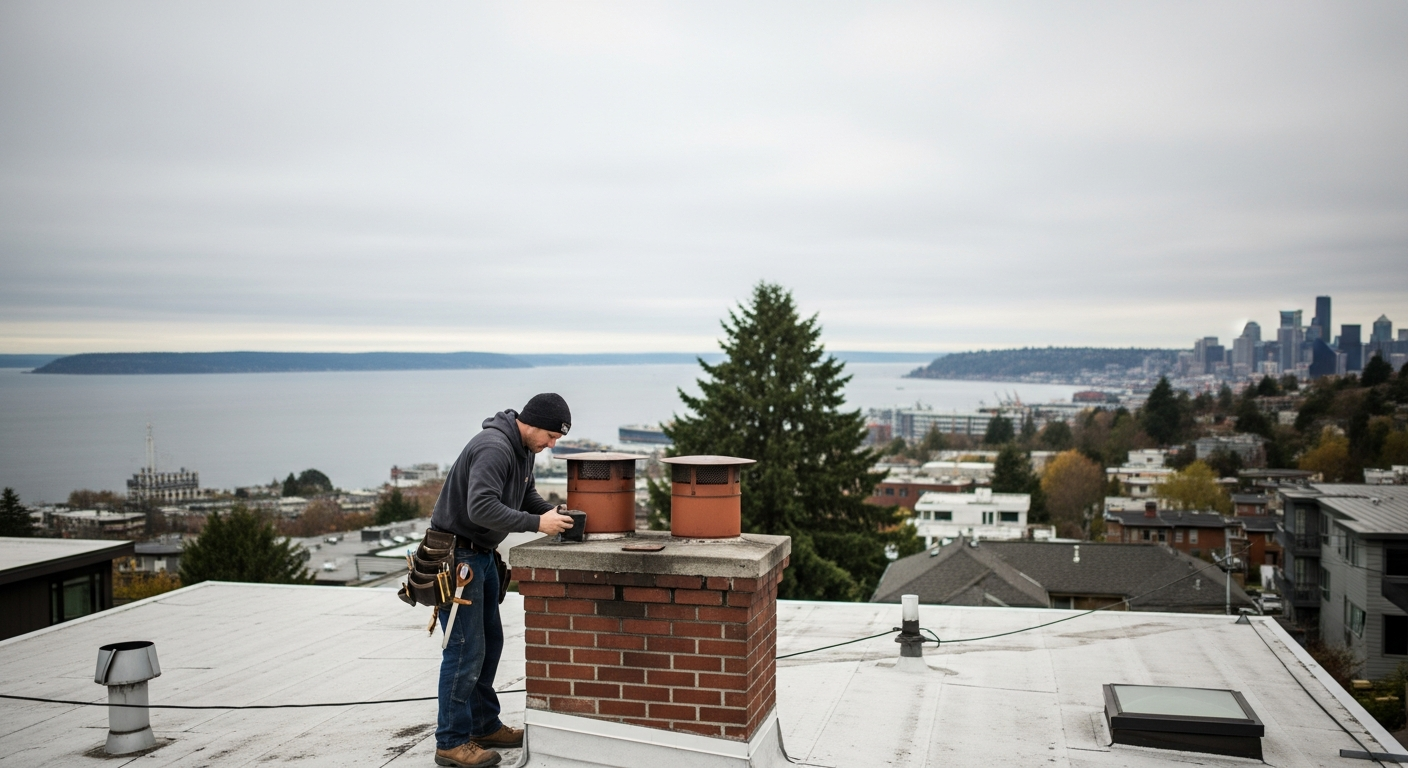
Some Seattle chimney companies use a staged, two-person escalation method: one technician performs a free or low-cost inspection, then a second person — introduced as an engineer or specialist — arrives to confirm serious damage and push a large contract. Knowing how this pressure sequence works lets you pause the conversation, leave without obligation, and get a truly independent assessment before spending a dollar.
How the Two-Person Escalation Works
The mechanic is simple and repeatable. A crew schedules a free inspection, often booked through a door-to-door canvass or a low-bid ad. The first technician documents what looks like alarming damage — photographs of cracked flue tiles, mortar gaps, or discolored liner sections — and expresses concern but stops short of quoting a price. He tells you a specialist needs to take a look.
Within minutes or hours, the second person arrives. He may carry a clipboard, wear a different uniform, or be introduced with a title like "our licensed engineer" or "our structural inspector." His job is social, not technical: to confirm the first person's findings with an air of authority, raise the urgency, and present a written contract — often in the range of several thousand dollars — while both people are still standing in your living room.
The pressure is architectural. Two strangers in your home, both agreeing the situation is dangerous, creates genuine anxiety. That anxiety is the product being sold.
Edward's Scenario: A Teaching Example
*The following is a hypothetical scenario, included to illustrate how this tactic unfolds. It is not a real customer account.*
Edward, a homeowner in Ballard, books a free chimney inspection after seeing a flyer on his door. The first technician spends forty minutes on the roof and in the firebox, then comes downstairs holding his phone with photos of what he calls "severe spalling" and a "compromised liner." He says he needs to call his manager — who happens to be nearby — to assess whether the chimney is even safe to use this winter.
The manager arrives twelve minutes later, reviews the photos, nods gravely, and hands Edward a written proposal for a full reline and crown rebuild: $4,800, with a same-day discount that expires at midnight. Edward feels the pull of that deadline. He signs nothing, says he needs the weekend to think, and books a paid inspection with a company he found through the ranking. That inspector finds minor mortar deterioration consistent with normal weathering — a $350 repair, not a $4,800 overhaul.
Typical Seattle Chimney Repair Costs vs. Pressure-Tactic Quotes
The table below uses typical ranges drawn from publicly available contractor estimates in the Seattle and Puget Sound market. Actual costs vary by chimney height, liner material, and access difficulty.
| Repair Type | Typical Seattle Range | Pressure-Tactic Quote Range | Notes |
|---|---|---|---|
| Basic sweep & inspection | $150 – $300 | Free (used as entry point) | Free inspections fund upsells |
| Minor mortar / tuckpointing | $200 – $600 | Often bundled into reline quote | Frequently overstated as structural |
| Chimney crown repair | $300 – $800 | $900 – $1,800 | Crown damage is real but rarely urgent |
| Full stainless liner installation | $1,500 – $3,500 | $3,500 – $6,000+ | Reline is legitimate; cost should be itemized |
| Cap replacement | $100 – $350 | $400 – $900 | Simple commodity item |
If a verbal or written quote lands consistently at the top or above these ranges and arrives with a same-day deadline, treat that as a process red flag, not necessarily a price one.
Five Concrete Steps to Protect Yourself
1. Name the dynamic out loud. You can say, calmly: "I appreciate you both coming out. I don't make major repair decisions the same day — that's just my policy." No explanation needed.
2. Ask for itemized documentation. A legitimate company will give you a written, line-item estimate you can take away and compare. Resistance to doing this is itself informative.
3. Request license and insurance numbers before anyone starts work. In Washington State, chimney contractors performing structural work typically need a contractor registration through the Department of Labor & Industries. You can verify any registration number at L&I's online lookup — free and takes two minutes.
4. Get a paid second opinion from an unaffiliated inspector. A Certified Chimney Professional (CCP) or Chimney Safety Institute of America (CSIA) certified sweep has no stake in selling you a reline. Expect to pay $150–$250 for an honest assessment — money that could save thousands.
5. Check complaint history before you book anyone. Our Chimney Repair Red Flags guide walks through how to read BBB complaint patterns and what Google review language to watch for.
Why the Engineer Title Carries Weight
Washington does license Professional Engineers (PEs), and that credential is meaningful. But chimney repair does not require a PE, and a PE is almost never present at a residential chimney sales call. When a company uses the word "engineer" informally — as a job title for a sales closer — it borrows institutional credibility without the accountability that comes with a licensed designation. Ask, politely and directly: "Is this person a licensed Professional Engineer in Washington State?" The answer is almost always no.
If you are genuinely unsure whether your chimney needs relining, the guide Signs Your Chimney Needs Relining: A Seattle Homeowner's Guide covers objective indicators — things you or an independent inspector can verify without buying anything first.
The Safest Default: Time and Distance
The two-person pressure tactic depends entirely on keeping you in the room, in a mild state of alarm, until you sign. The antidote is straightforward: leave the conversation. Thank both people, keep the paperwork they gave you, and take at least 48 hours. A real chimney problem that developed over years does not become an emergency in two days. Any contractor who insists otherwise is selling urgency, not repair work.
Frequently asked questions
- Is it legal for a chimney company to call someone an 'engineer' if they aren't licensed?
- Washington State licenses Professional Engineers through the Department of Licensing, and using that title without a license is regulated. However, companies sometimes use 'engineer' informally as a job description rather than a credential claim. Ask directly whether the person holds a current Washington State PE license and request the license number — you can verify it through the state's online lookup at no cost.
- How do I find an independent chimney inspector in Seattle who isn't trying to sell me repairs?
- Look for inspectors holding CSIA (Chimney Safety Institute of America) certification or the Certified Chimney Professional (CCP) designation. Confirm they do not also sell liner or rebuild contracts, which creates a conflict of interest. Expect to pay $150–$250 for a paid inspection. You can also check our eight-measure ranking at SeattleChimneyAdvisor.com to compare companies on technician quality and complaint history before booking.
- What is a realistic cost for a chimney reline in Seattle, and how do I know if a quote is inflated?
- A full stainless steel liner installation in the Seattle and Puget Sound area typically runs $1,500–$3,500, depending on flue length, liner diameter, and access. Quotes above that range are not automatically fraudulent, but they warrant scrutiny. Ask for a line-item written estimate, compare it against at least one other company, and verify the contractor's L&I registration number before agreeing to any work.